
Surface Helium Detonation Spells End for White Dwarf
An international team of researchers has found evidence that the brightest stellar explosions in our Universe could be triggered by helium nuclear detonation near the surface of a white dwarf star. Using Hyper Suprime-Cam mounted on the Subaru Telescope, the team detected a type Ia supernova within a day after the explosion, and explained its behavior through a model calculated using the supercomputer ATERUI. This result was reported in Nature published on Oct. 5.
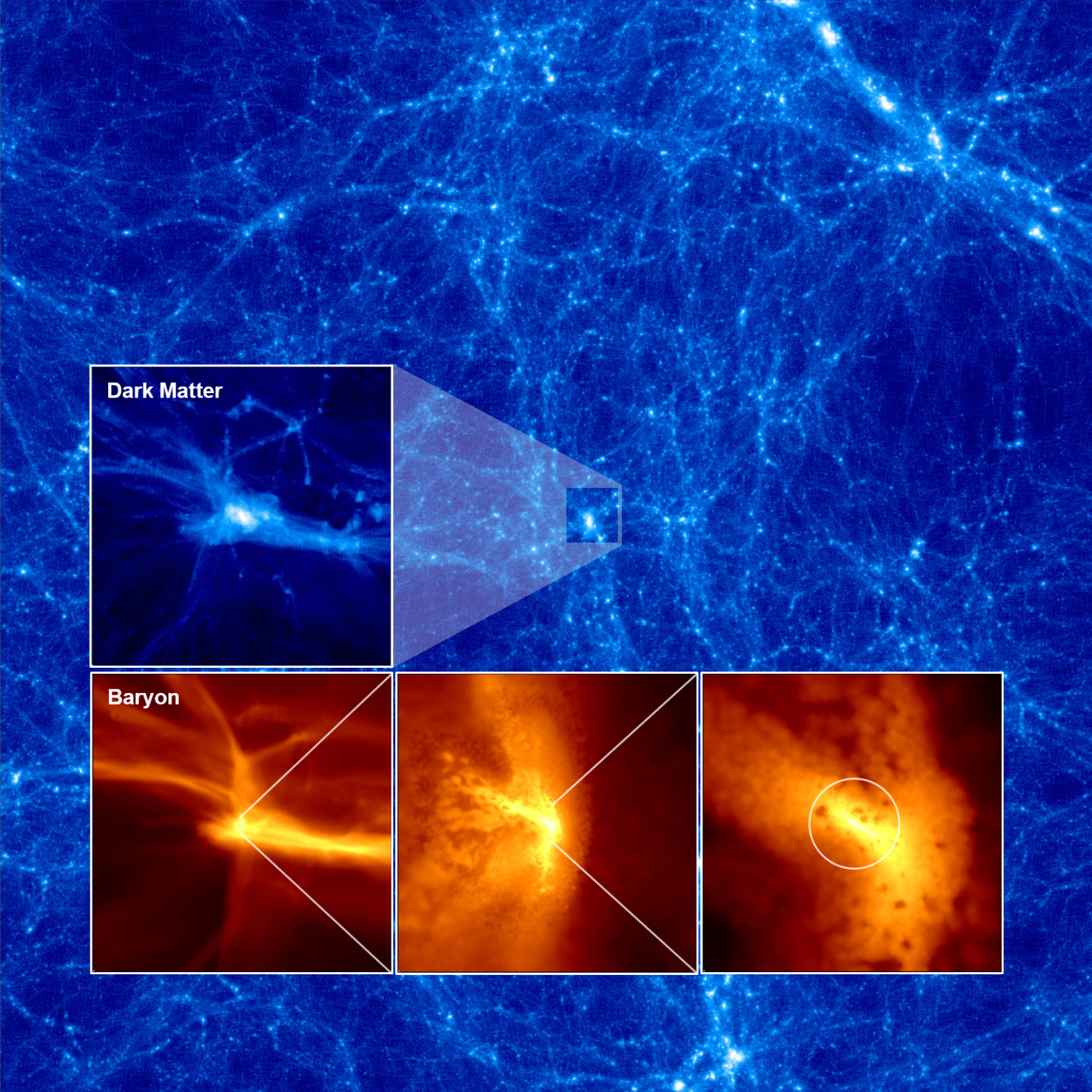 An international team of researchers has successfully recreated the formation of a massive black hole from supersonic gas streams left over from the Big Bang using a supercomputer ATERUI. Their study, published in this week’s Science, shows this black hole could be the source of the birth and development of the largest and oldest super-massive black holes recorded in our Universe.
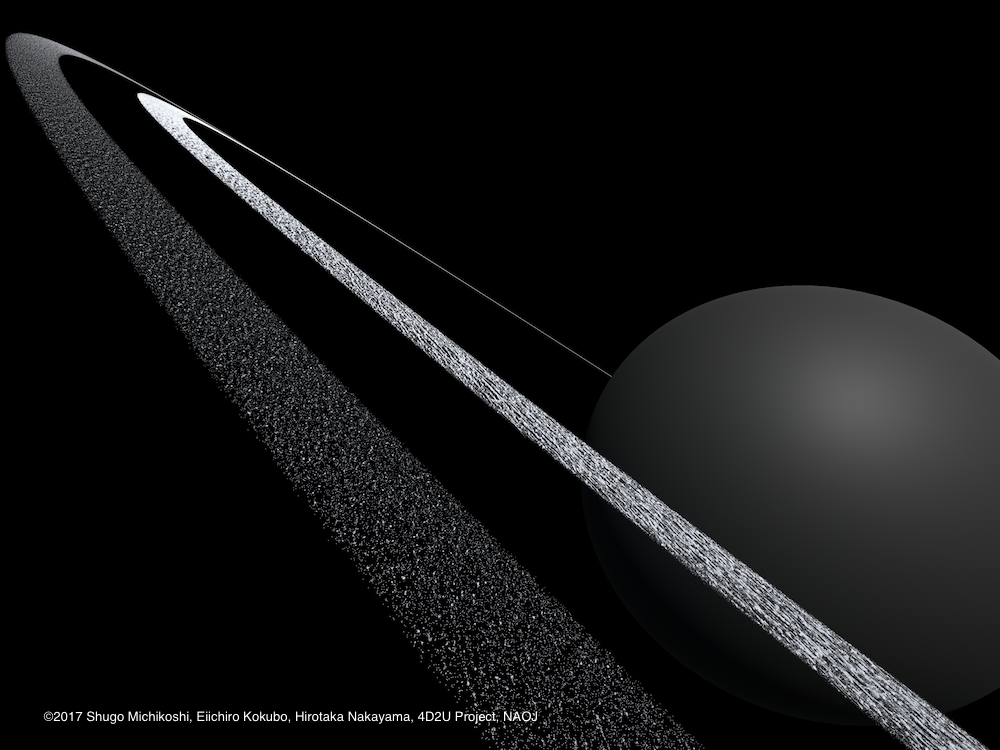 A team of researchers in Japan modeled the two rings around Chariklo, the smallest body in the Solar System known to have rings. This is the first time an entire ring system has been simulated using realistic sizes for the ring particles while also taking into account collisions and gravitational interactions between the particles. The team’s simulation revealed information about the size and density of the particles in the rings. By considering both the detailed structure and the global picture for the first time, the team found that Chariklo’s inner ring should be unstable without help. It is possible the ring particles are much smaller than predicted or that an undiscovered shepherd satellite around Chariklo is stabilizing the ring. (Press Release: April 28, 2017)