
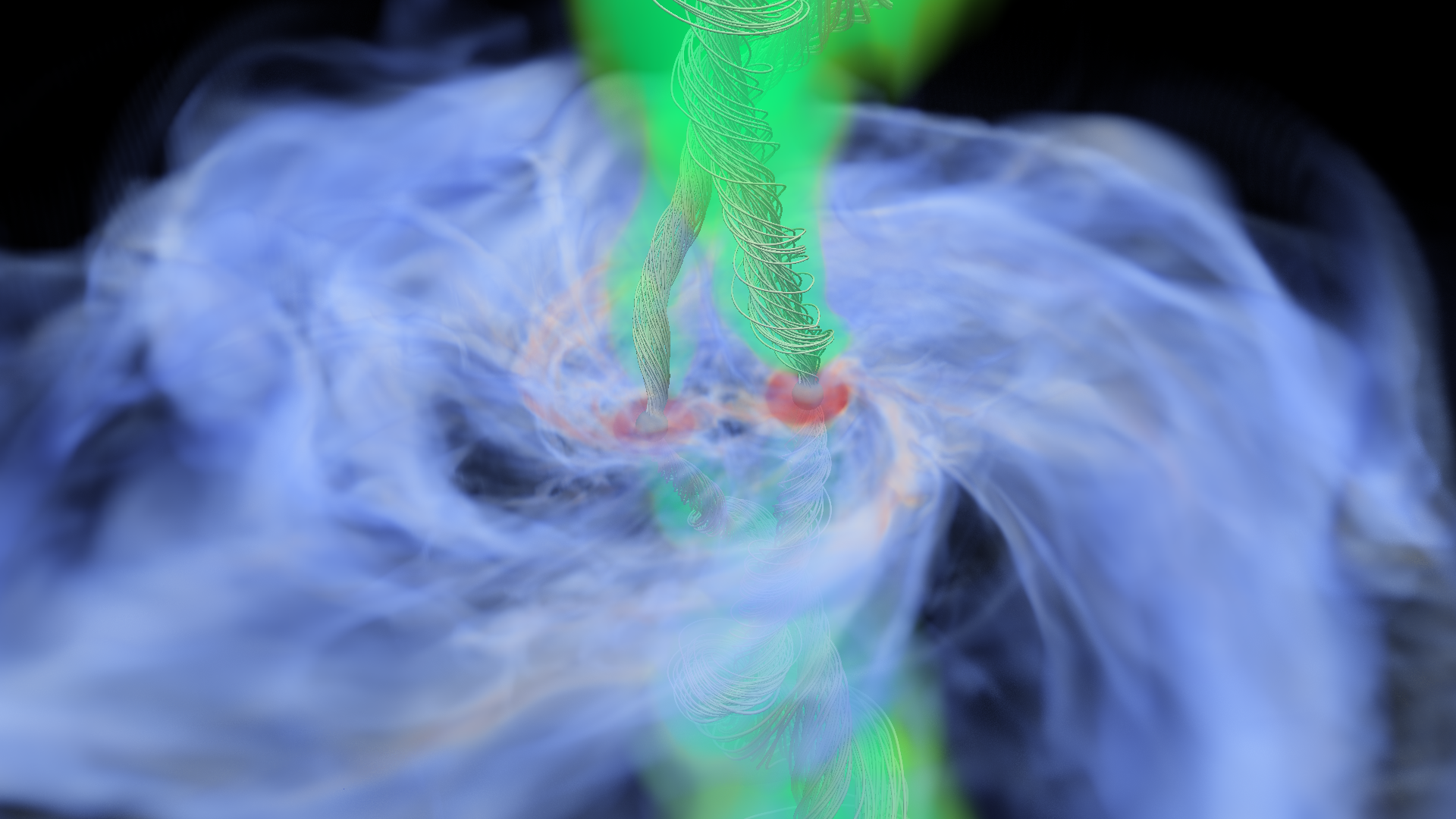
New simulations show that interactions with a magnetic field can work to decrease the distance between still forming binary protostars. These results can help explain the characteristics of the binary star systems observed in the Milky Way. These results can also be extrapolated to binary black holes, giving insights into how super massive black holes evolve.
Download: [PNG (1.82 MB)]
Stars form from clouds of interstellar gas that collapse into dense regions known as molecular cloud cores. Multiple stars form close together simultaneously, and in some cases two stars will become gravitationally bound to each other, forming a binary star system. Observations suggest that these binary systems form early on, before the stars are even fully formed. Astronomers have struggled to explain how these still forming “protostars” can pull together into binary systems so quickly.
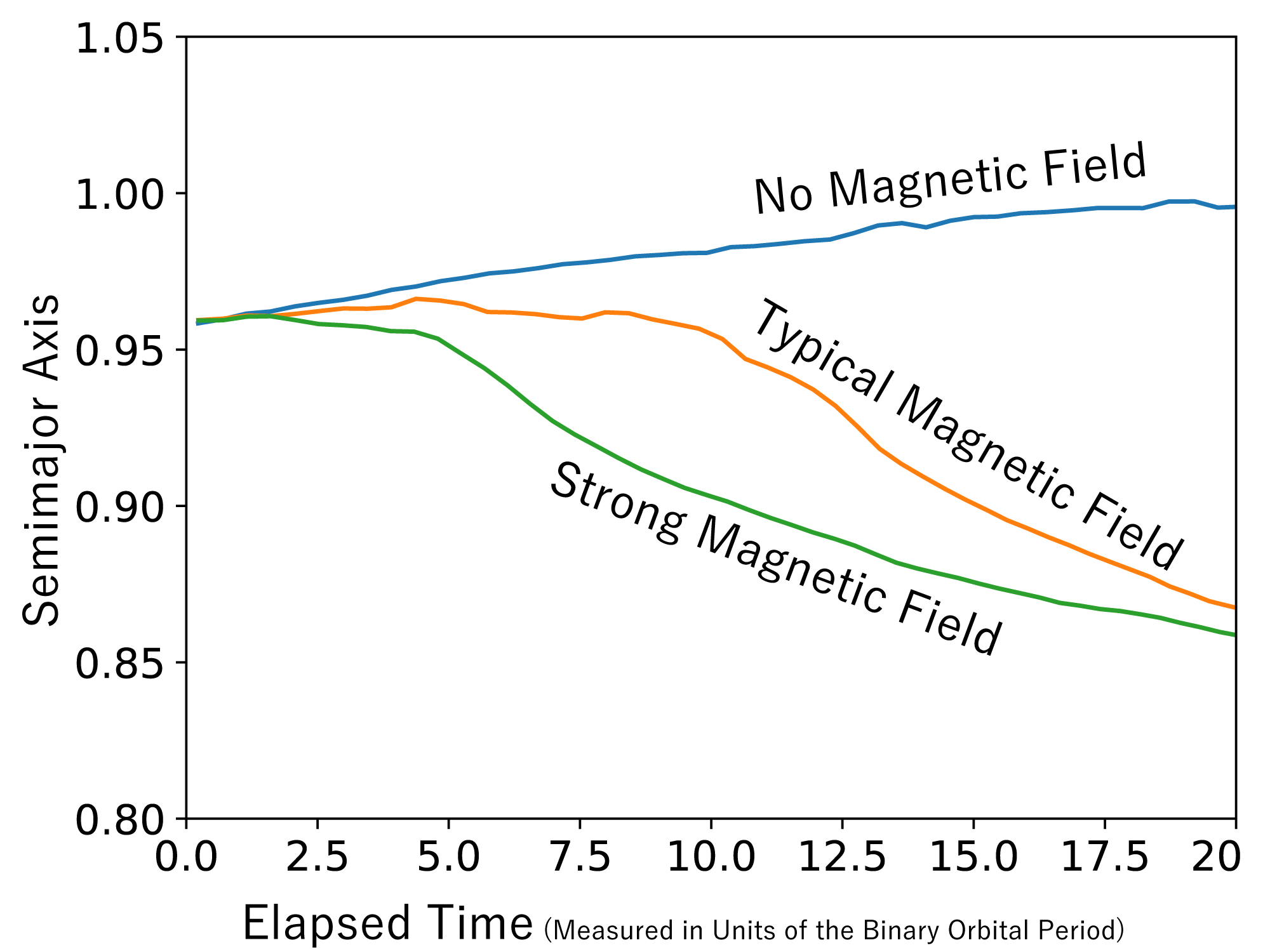
New simulations using multiple supercomputers including the ATERUI III supercomputer for astronomical simulations and its predecessor ATERUI II, both at the National Astronomical Observatory of Japan (NAOJ), have shown that interactions between an interstellar magnetic field and the gas around the protostars can remove angular momentum from the protostar pair, allowing the binary systems to form within a realistic time period. In the simulation run with zero magnetic field performed as part of this research, the protostars actually moved farther apart, indicating the importance of the magnetic field in the process.
Download: [MP4 (19.25 MB)]
The simulations also suggest that the same process could work on massive binary black holes in the gas-rich heart of a new galaxy formed from the merger of two smaller galaxies. This would help explain how massive black holes can move close enough to merge and form a supermassive black hole. Direct simulation of massive binary black holes over the timespans required to spiral towards each other is still computationally challenging, so rigorous investigation of the effects of magnetic fields on massive binary black holes remains a topic for future investigation.
Download: [PNG (56 KB)][PDF (121 KB)]
(June 5, 2026 Press Release)
Publication Information
Title: "Magnetic-field-induced inspiral of binaries with circumbinary disc: black hole and protostellar systems"
Authors: Tomoaki Matsumoto (Hosei University), Kenta Hotokezaka (The University of Tokyo), Kohei Inayoshi (Peking University)
Journal: Monthly Notices of the Royal Astronomical Society
DOI: 10.1093/mnras/stag669
Supercomputers Used in This Research


This study used the NAOJ’s astronomy-dedicated supercomputers, ATERUI II (Cray XC50; left) and ATERUI III (HPE Cray XD2000; right). ATERUI II, which was operated until August 2024, had a peak theoretical performance of 3.087 petaflops (one petaflop corresponds to one quadrillion calculations per second). Its successor, ATERUI III, began operation in December 2024. With a peak theoretical performance of 1.99 petaflops, ATERUI III consists of two subsystems: System M, which provides high memory bandwidth, and System P, which offers large memory capacity. (Credit: NAOJ)