
In a new study, researchers at the Max Planck Institute for Astrophysics collaborated with their Japanese counterparts to solve a long-standing mystery in modern astrophysics: how supermassive black holes formed so quickly in the early Universe. The team used the most detailed cosmological simulations to date, carried out on the National Astronomical Observatory of Japan’s dedicated astronomy supercomputer ATERUI III, to show that massive black hole seeds with masses up to a million times that of our Sun can form naturally in dense, early galaxy clusters. These seeds grow rapidly through super-Eddington accretion, which explains the existence of the 'Little Red Dots' (LRDs) observed by the James Webb Space Telescope (JWST). This study unifies the formation of these early black holes with the evolution of the first galaxies, offering a comprehensive understanding of how the Universe's most powerful objects came into existence just a few hundred million years after the Big Bang.
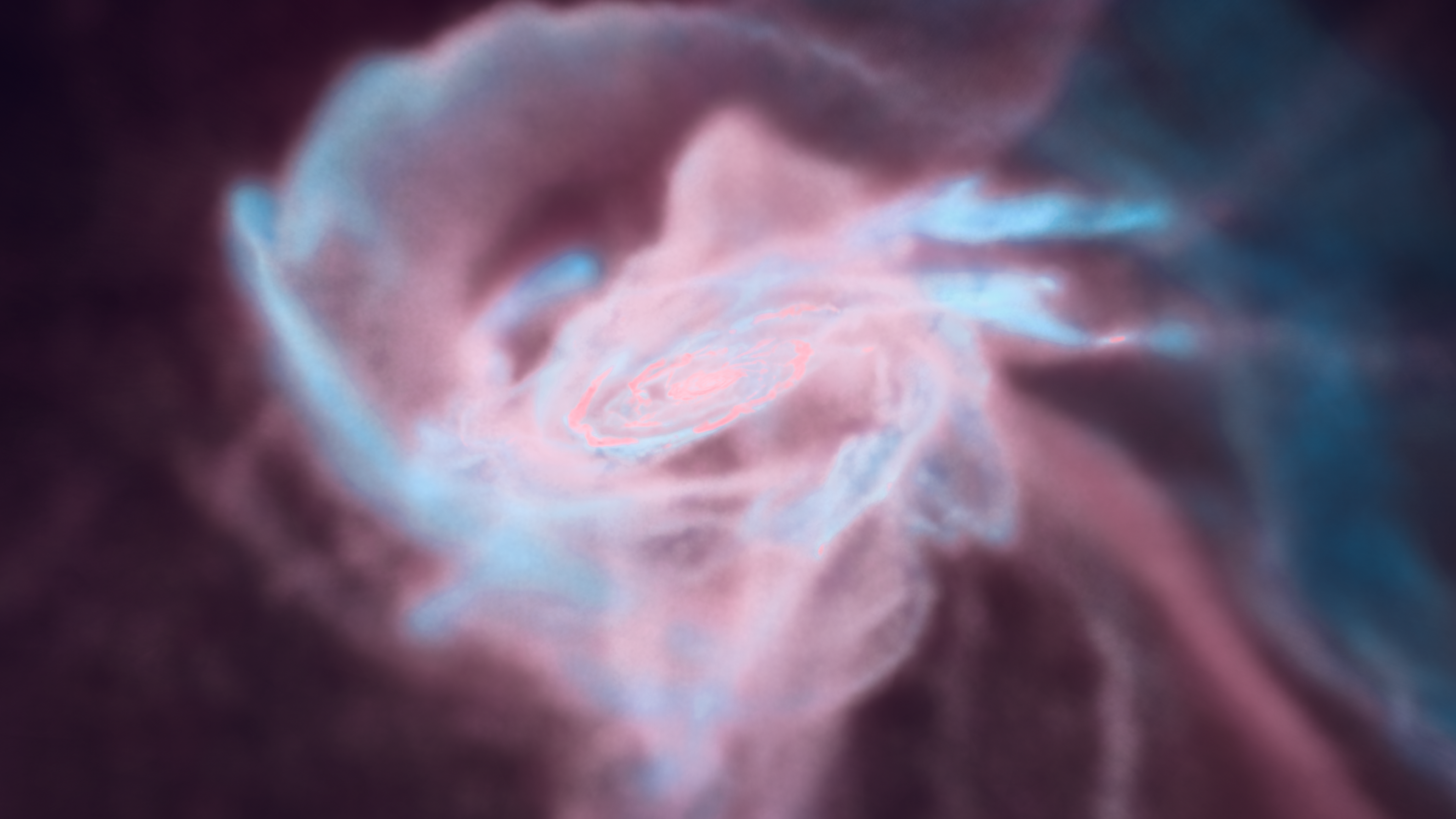
Download: [PNG (1.82 MB)]
Just a few hundred million years after the Big Bang, the Universe already contained supermassive black holes with millions or even billions of times the mass of our Sun. How such giants could form so quickly has puzzled astronomers for decades. Now, a new study led by Sunmyon Chon at the Max Planck Institute for Astrophysics (MPA) has unveiled a compelling answer using sophisticated simulations of the early Universe. The high-performance computing capabilities of ATERUI III made these simulations possible.
The research reveals that massive black hole seeds—with up to 1 million times the mass of the Sun—can form naturally in dense, early galaxy clusters, without requiring exotic or finely tuned conditions. These seeds then grow at astonishing speeds, rapidly evolving into the supermassive black holes observed by the James Webb Space Telescope (JWST) in the distant early Universe.
The key to this breakthrough lies in a powerful effect that has often been overlooked in cosmological simulations: intense far-ultraviolet (FUV) radiation from nearby star-forming galaxies. In the early Universe, massive galaxies formed in dense clusters. The radiation from these galaxies suppressed star formation in nearby gas clouds, preventing them from cooling and fragmenting into smaller stars. Instead, the gas collapsed directly into a single, massive object: a supermassive star, which then collapsed into a black hole seed larger than any previously known examples.
“This is the first time we’ve seen such massive seeds form in a full cosmological simulation,” says Sunmyon Chon (MPA), lead author of the study. “We didn't assume anything special: no fine-tuned conditions, no artificial triggers. The physics of radiation, gravity and gas dynamics naturally led to the formation of these heavy seeds.”
The simulations show that, once formed, these black hole seeds are surrounded by dense, optically thick gas disks. This environment traps radiation, enabling the black holes to accrete matter at rates tens of times faster than the Eddington limit, which is a theoretical maximum. This 'super-Eddington' phase lasts only a few hundred thousand years, but that is long enough for the black hole to grow from 1 million to 30 million solar masses by redshift z ≈ 8—just 600 million years after the Big Bang.
Download: [MP4 (19.25 MB)]
This is where the ‘Little Red Dots’ come in. JWST has recently discovered a mysterious population of compact, red sources at redshifts z > 4–6. These 'Little Red Dots' (LRDs) are faint in visible light, but bright in the infrared spectrum, showing strong hydrogen emission lines and red continua—signatures of dense, obscured gas. Until now, their origin had been a mystery.
The new simulations show that LRDs are not just distant galaxies; they are short-lived, obscured phases of massive black hole formation. The dense gas surrounding the growing black hole acts like a cosmic cocoon, scattering light and producing the red, feature-rich spectra observed by JWST. The strong Hα emission originates directly from the dense gas surrounding the black hole, rather than from a separate broad-line region.
“This is a perfect match,” explains Chon. “The simulations reproduce the exact spectral features of LRDs naturally. We’re not just explaining the black hole mass; we’re explaining the entire observational signature.”
The study also resolves a long-standing paradox: why some early black holes are far more massive than expected based on local scaling relations. The answer lies in the early, rapid growth phase. Once the black hole has settled into a galaxy, it continues to grow, albeit at a slower and more stable pace. The formation of the massive seed in the first few hundred thousand years sets the stage for the supermassive black holes observed today.
The implications go far beyond black holes. These early, massive seeds probably played a vital part in shaping the first galaxies by driving powerful outflows and influencing star formation. They are also the most likely progenitors of the gravitational wave sources that will be detected by future missions such as LISA.
“This work connects the dots between the first stars, the first black holes, and the first galaxies,” says Volker Springel, senior author and director at MPA. “We’re not just simulating black holes – we’re simulating the birth of the cosmic structures we see today.”
As JWST continues to reveal more LRDs and future telescopes probe deeper into the early Universe, this new model provides a powerful roadmap for understanding how the cosmos evolved from darkness to light.
“We’ve shown that the universe’s most massive black holes didn’t need a miracle – they just needed the right conditions,” Chon summarises. “And those conditions were already present in the early cosmos.”
Reserch Information
Title: Overmassive black holes and little red dots naturally form in simulations
Authors: Sunmyon Chon et al.
Journal: Nature
DOI: 10.1038/s41586-026-10985-8
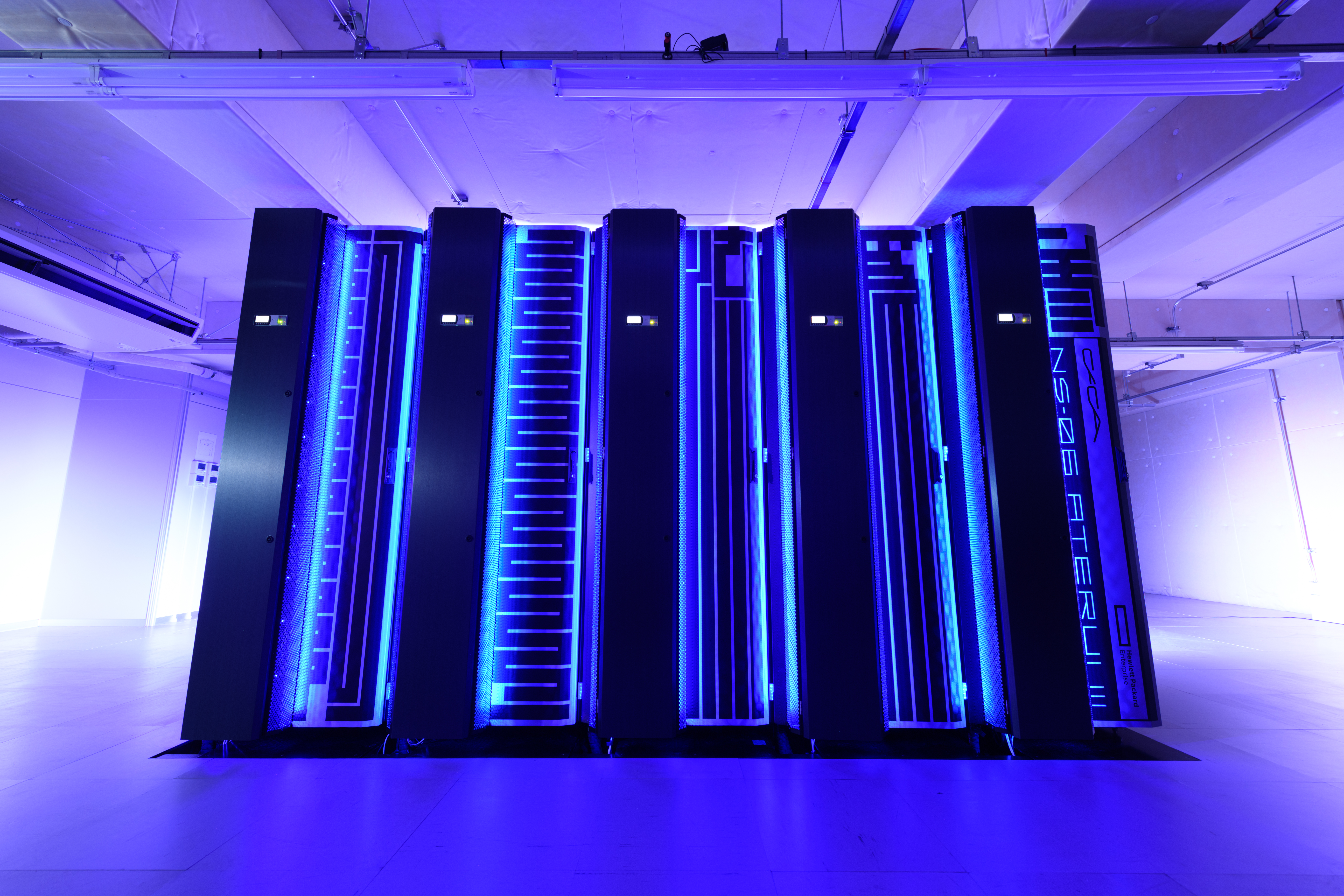
Supercomputer Used in This Study
Related Links
MPA: How the Universe’s First Supermassive Black Holes Were Born: New Simulations Reveal the Secrets of 'Little Red Dots'
NAOJ: Japanese Supercomputer Explains Webb's Little Red Dots
Chiba University: Japanese Supercomputer Explains Webb’s Little Red Dots